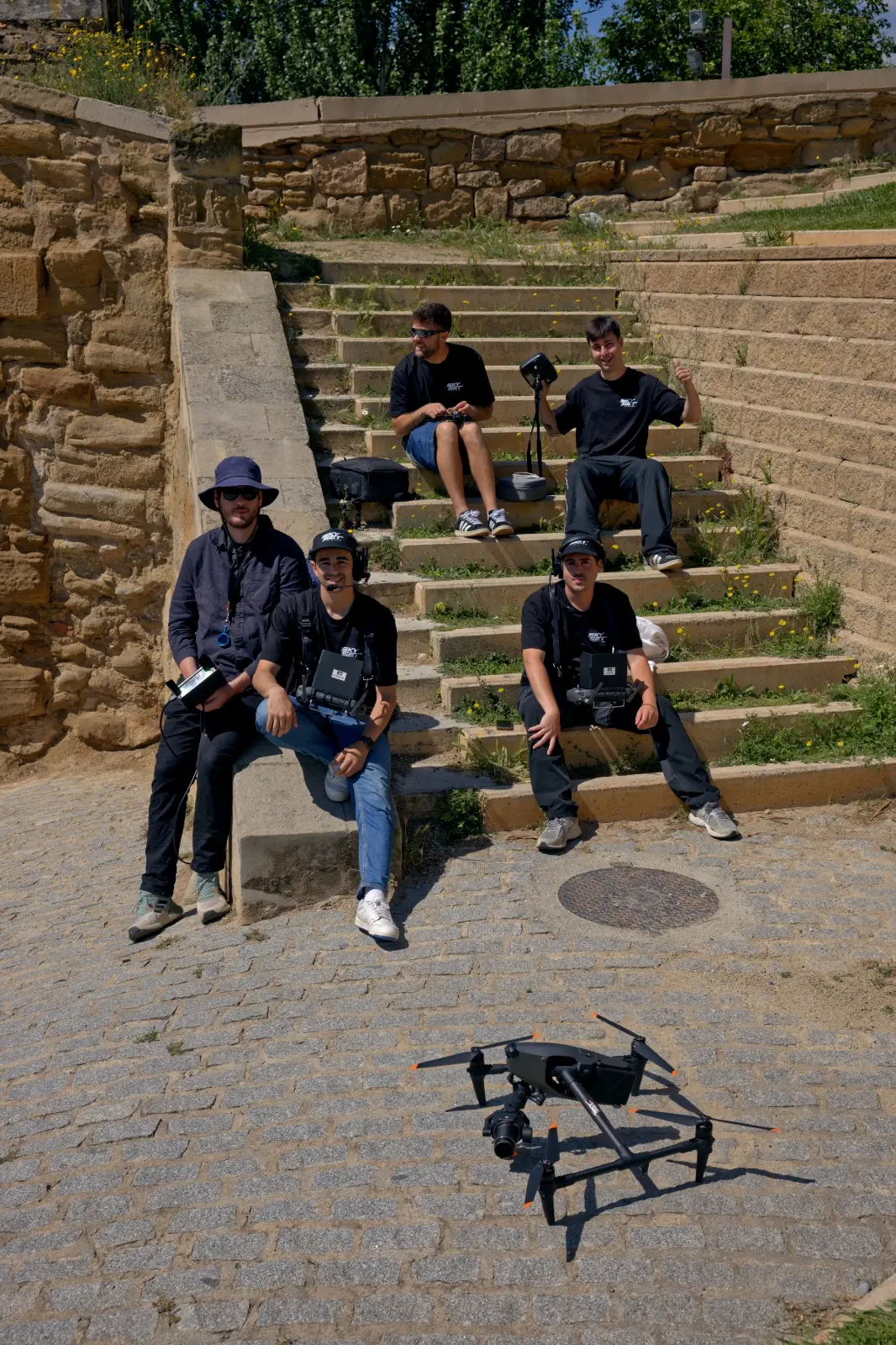
Every time a production company gets in touch, the first question is usually about the shots and the second about the paperwork. Fair enough: in Spain, flying a drone on a professional shoot is regulated, and a badly handled permit can wreck a whole day. This note sums up, in production language rather than legal jargon, what to bear in mind in 2026.
"The permit isn't for the drone, it's for the location, the altitude and the people underneath. Change any one of the three and the process changes."
1. The operator must be registered with AESA
The Agencia Estatal de Seguridad Aérea (AESA) is the authority. Any company flying drones for professional purposes must be registered as a UAS operator and display the operator number visibly on the aircraft. Each pilot also needs the remote pilot certificates appropriate to the operation: A1/A3 and A2 for the open category, and the standard scenarios STS-ES-01 and STS-ES-02 for the specific category.
The first thing a production company should ask any drone unit for is the operator registration number, the pilots' certificates and the insurance. We send these along with the quote.
2. Open or specific category: the difference that matters on set
European regulations divide operations into categories based on risk. On an actual shoot, the practical distinction is this:
- Open category: visual line of sight, away from people not involved in the operation, and at low altitude. It works for landscapes, open exteriors and some automotive shots with the road closed. It doesn't require prior authorisation, but it does require meeting the conditions of the subcategory (A1, A2 or A3) and any local restrictions.
- Specific category: when there are people not involved nearby, an urban setting, heavier aircraft, or flights beyond visual line of sight. Here you fly under a standard scenario (STS-ES-01 in populated areas, STS-ES-02 outside them), a PDRA or a SORA risk assessment. It requires a prior declaration or authorisation from AESA and an operations manual.
An Inspire 3 with a cinema camera and an FPV cinelifter usually fall into the specific category as soon as the shoot gets close to a populated area or to people outside the crew. That's why we plan the category shot by shot at the recce, not on the shoot day.
3. Controlled airspace: coordination with ENAIRE
Every airport has controlled airspace (a CTR) around it, and many cities have restricted or prohibited zones. Flying there requires prior coordination with ENAIRE, the air navigation manager, and in some cases the publication of a NOTAM. Madrid, Barcelona, the Alicante coast or the area around Corvera Airport in Murcia are common examples.
The realistic timeline for coordination in controlled airspace is two to four weeks. If the commercial has a fixed air date, this is the first process to get moving.
4. Urban environments: AESA isn't the only authority
Filming in a city adds layers. On top of the specific category and any ENAIRE coordination, the local council has to authorise the shoot and the use of public space, and the local police usually get involved when there are traffic closures. At monuments and protected heritage sites, whoever holds the property may have their own authorisation process.
5. Protected natural areas
National parks and many nature reserves require authorisation from the managing body, on top of the aviation side. At Cabo de Gata, for example, that's the Junta de Andalucía; in the Pyrenean parks, each region and each park has its own procedure. Timelines run from two to four weeks and, during nesting season, some areas are closed to flights.
Indicative timelines by location
| Rural, no restrictions | Days · open category or STS declaration |
| Controlled airspace (CTR) | 2–4 weeks · ENAIRE coordination |
| Urban area | 2–4 weeks · AESA + local council + local police |
| National / nature park | 2–4 weeks · park authority + AESA |
| Restricted monument | 4–6 weeks · property holder + local council + AESA + NOTAM |
6. Insurance and paperwork a production should request
Aviation liability insurance is mandatory and different from standard business insurance. Before signing with a drone unit, a production should have on file:
- UAS operator registration number with AESA
- Remote pilot certificates for whoever will be flying
- A current aviation liability insurance certificate
- Declaration or authorisation for the operation when it's the specific category
- ENAIRE coordination or a NOTAM if the flight is in controlled airspace
- Location authorisations: local council, owner, park or property holder
7. What we need from the production
To get the paperwork moving without losing days, this is all we need:
- Exact location (coordinates or a KML file) and dates with times
- Type of shots and approximate altitude; whether there's any tracking of vehicles or people
- Whether there will be members of the public, cast or crew beneath the flight area
- Any permits the production already holds for the location
- A contact for the production manager or the production service
"With the location and dates confirmed, the permit is a formality. Without them, it's a gamble."
How we quote it
Permits are quoted by type of location (studio or private estate, standard, controlled or urban airspace, and bespoke SORA assessments) and itemised separately from the shoot day. We detail them in the quote alongside the Inspire 3 and FPV days; the 2026 rate card is sent on request and isn't published. If you already have a specific location in mind, write to us with the dates and we'll tell you what permit it needs and how long it takes.