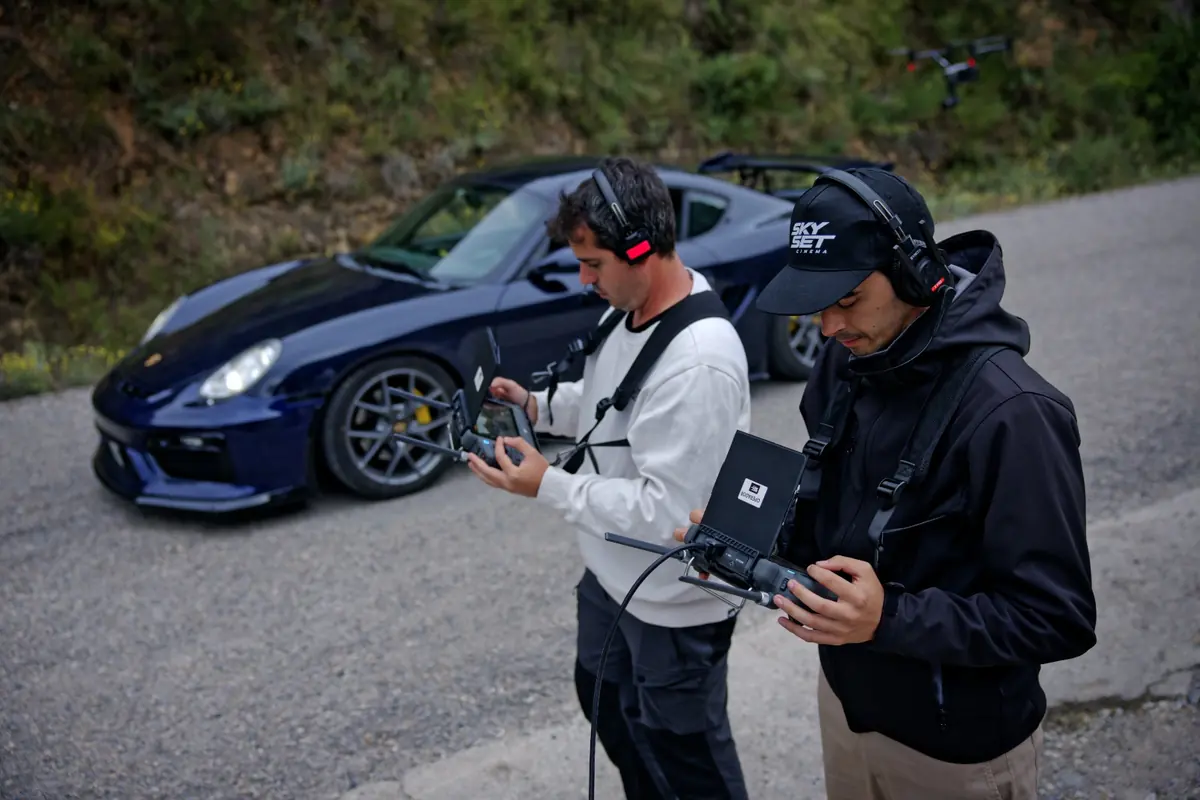
The hard part of filming cars from the air isn't the drone. It's understanding what the driver is about to do before he does it. When you're flying an Inspire tracking a Porsche down a mountain road at 80 km/h, there's no margin to react: you have to be where the car will be three seconds from now.
These are some notes we've jotted down after several automotive shoots this year, almost all with sports cars on secondary roads inland in Spain.
"The driver isn't talent, he's part of the camera crew. The sooner you accept that, the better the day goes."
The driver briefing calls the shots
Before the first pass, we sit the driver down with the operator's monitor so he can see exactly what framing we're after. It's not a formality: it's the difference between him carrying the racing line through the key corner or falling short right when we had the composition.
We always go over three things: the start point of the pass, the point where we want the car at the moment of maximum tension in the shot (the apex, the tunnel exit, passing under the bridge) and the end point. Three marks. If the driver has them clear, everything else falls into place on its own.
A pass that looks complicated on the storyboard becomes trivial once the driver knows exactly which metre he needs to be flat out at. The complication comes when you improvise.
Real-world speeds (and why they're almost never what's in the script)
The technical script usually says "the car at 120 km/h". In practice, for the shot to work cinematically:
- In a lateral tracking shot with the Inspire, around 60–80 km/h is already enough perceived movement
- In a high or top-down angle, the car can go faster without losing shot stability
- Head-on and approaching, it's better to lower the real speed and compensate in post with a light ramp
- For any shot going to slow motion in post, we film at 50 or 100 fps and the car can go even slower
The client and the production often ask for more speed than necessary because "it looks more spectacular". In most cases, it doesn't. What looks spectacular is the composition, the sound of the car in the mix and well-exposed 8K grain.
Typical set-up for an automotive day
| Platform | DJI Inspire 3 |
| Optics | DL optics swapped depending on the pass |
| Format | 8K ProRes RAW |
| Profile | D-Log |
| FPS | 25p for real time, 50p or 100p for slow-mo |
| Communications | Radios between pilot, operator and driver |
| Crew on set | 2 (pilot + operator) + 1 driver + traffic assistant |
The first take is almost never the keeper
However tight the plan, we use the first pass of every shot to calibrate. The driver adjusts his line, the pilot adjusts height and distance from the car, the operator adjusts the framing. We get something on record, but it's rarely the final take.
From the second or third pass we start getting usable material. For a long pass (10–15 seconds of shot) we usually plan for 4 to 6 repeats, assuming two or three won't work because of wind, framing or the car itself.
"If the producer tells you 'we'll manage with two passes', there's going to be a problem. Ask for four and sleep easy."
Communications and safety
We run every automotive shoot with radios between the three positions: pilot, operator and driver. The pilot counts down to start the pass, the driver confirms when he's in position, the operator confirms when he has the framing. If any of them aborts, we all abort.
We always work with the road closed or controlled by a traffic assistant. Even at low speed, a drone over a moving car is still an operation that can't allow oncoming traffic, pedestrians or vehicles pulling out of side roads. We deal with that during the recce, before bringing anyone to set.
Why we like this kind of shoot
What makes filming cars from the air special is that it combines pure coordination with cinematic composition. It's very technical — speeds, distances, communications — but the final result depends on things as abstract as when the car enters the frame, how much sky you leave above it, or whether the sun is at three-quarter angle or backlighting.
After several months with cars, what's become clear to us is that the drone pilot's job and the driver's job are the same job. If either one improvises, it doesn't work.