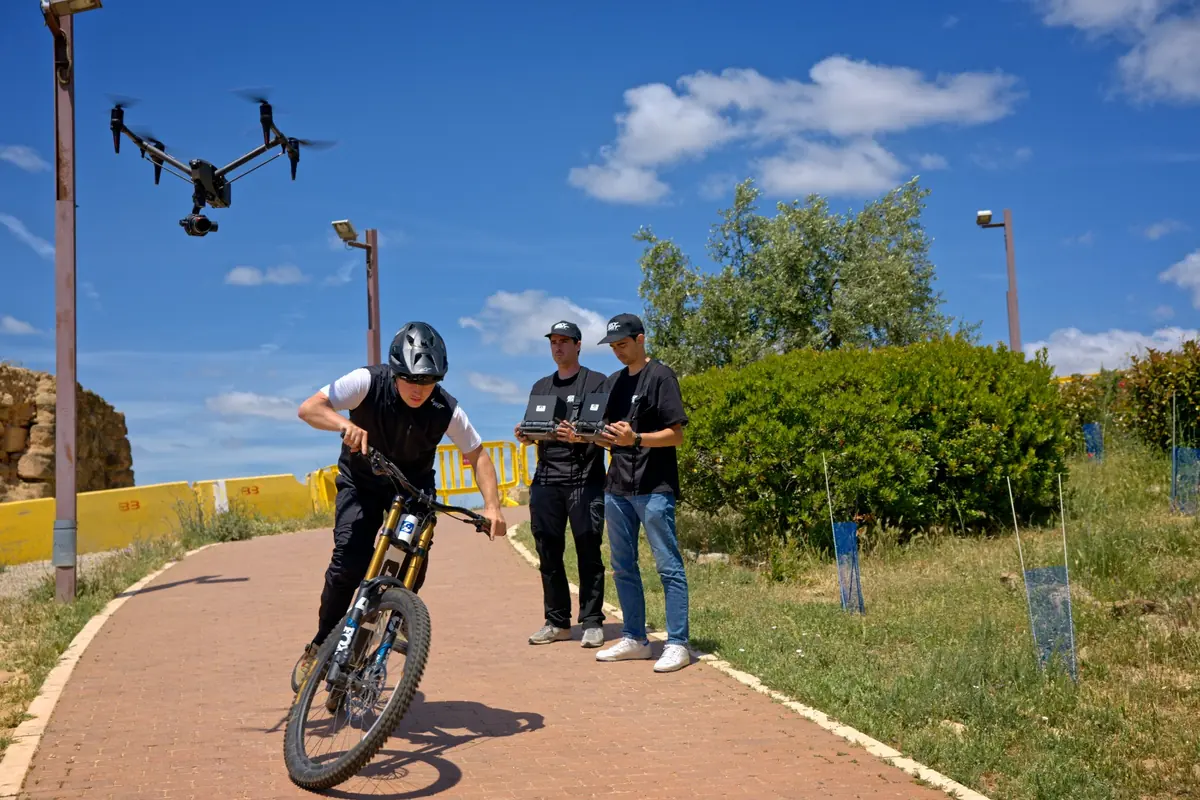
Working with a professional rider is different from working with actors. Actors do what the director says. Riders do what can be done without getting themselves killed. It’s a difference in framing that changes the whole dynamic of the shoot.
These are some of the things we’ve learned over days spent with freestyle motocross riders, downhill bikers and other riders. Things we wish someone had told us before our first shoot.
"On a normal set, the director calls the shots. In action sports, the director suggests and the rider decides. Get the roles confused, and the shoot doesn’t end well."
The rider is talent AND a specialist
The first mental adjustment: the rider isn’t an actor hitting marks. They’re a specialist who knows the limits of their discipline, their gear and their body. They know which jump they can repeat 8 times and which one they shouldn’t do even once. And they know it better than anyone.
Our job is to tell them what shot we need and let them decide how, where and how many times it’s done. When the rider says "I’m not doing this trick again today", that’s it. No discussion.
That sounds obvious written down like this. On set, under pressure from a client who wants "one more pass just in case", it isn’t so obvious. It has to be actively defended.
How we prepare an action sports shoot day
What has saved us the most trouble is investing time the day before the shoot:
- A visit to the track or location with the rider: they show us the line, mark the exact point of the trick, and identify which parts are technical and where improvisation is allowed
- Physical marking: cones or tape to mark the start, apex and exit of each take. The drone pilot memorises these references visually from above
- Pass plan: instead of "let’s see how it goes", we lock in a running order: pass 1 without the drone (calibrating the rider), pass 2 with the drone at medium distance, pass 3 close in, pass 4 if all goes well, for the hero shot
- An honest conversation about the number of repetitions: we ask the rider how many times it’s reasonable to do each trick before fatigue builds up. That’s the only number that matters
Equipment and communications
| Usual platform | DJI Inspire 3 / FPV depending on the pass |
| Recommended FPS | 50p minimum, 100–200p for slow-mo |
| Minimum distance from the rider | 3–4 m on a side pass · 5+ m on a front pass |
| Communication | Radio between pilot, operator and the rider’s spotter |
| Skyset crew | 2 (pilot + operator) + ground spotter |
Rehearsal passes with no footage recorded
We always do the first pass of the day without recording, just to calibrate. The rider runs their line at real speed, we fly the planned flight path. We watch on the monitor to see how it all fits together, and adjust the drone’s height, distance and tracking speed. Only then do we start recording for real.
This costs the rider one extra pass and 5 minutes of the day. In exchange, the next three passes are usable, and the rider doesn’t burn out doing tricks that were going to go wrong because of poor drone positioning, not because of anything on their part.
"One calibration pass saves three passes of frustration. That’s the maths."
Real safety margins
Flying close to a rider in motion means working within a small margin. The basic rules we always stick to:
- We never fly directly over the rider, on a path that would hit them if the drone failed
- If the rider is about to do an aerial trick (a jump, a wheelie, a manual), the drone is positioned to the side or behind, never above
- The rider’s ground spotter always keeps visual contact with the drone. If they see anything wrong, they call the abort, not the pilot
- Helicopter, protective helmet and any of the rider’s safety equipment are non-negotiable, even if they "get in the way of the shot"
Sometimes the client doesn’t understand why we say no to a certain shot. The short explanation is: we can’t promise that everything will still be fine on the tenth repeat. And the shot isn’t worth it if the risk starts climbing after the fourth.
Why we like this kind of shoot
When everything lines up — rider ready, drone on exactly the right path, good light — you get the kind of shot that defines a project. A tracking shot of an MTB rider descending, or a motorbike mid-jump with the drone right alongside, is about as cinematic as it gets from the air.
But the path to getting there isn’t technical, it’s human. The hard part isn’t flying the drone, it’s coordinating with someone who is putting something on the line with every pass. That’s what separates a good action-sports shoot from one that just gets lucky.